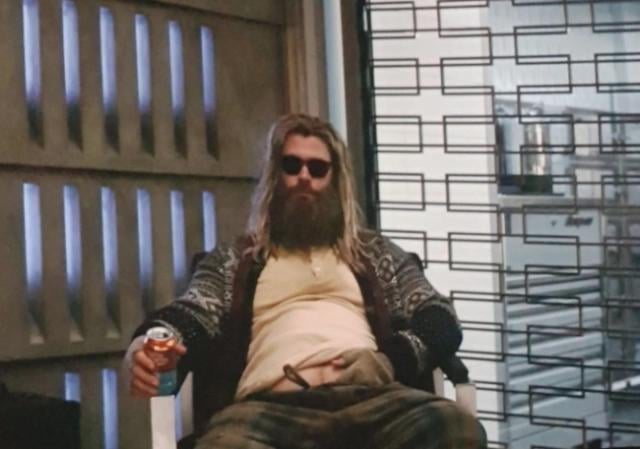
Anyone else actually like Fat Thor?
Endgame spoilers if you SOMEHOW haven't watched it yet
Fat Thor in Avengers: Endgame was one of the most controversial writing decisions in that movie, and for understandable reasons. A lot of people were mad that they made the awesome God of Thunder into a beer guzzling basement dweller who plays Fortnite all day, and a lot of other people felt that the film treated Thor's depression disrespectfully, like it was just a gag. But rewatching Endgame for the new year, I actually feel like Thor's arc in this film is more serious than a lot of people give it credit for.
Thor at this point is a man who has lost everything. His whole family is dead. Most of his people are dead. His home is rubble. He personally failed to save half the universe. He's more than depressed: He's utterly broken and despises himself. So he drowns himself in hedonistic pleasure because he can't stand reality anymore.
Something I noticed is that for all the claims that Thor's depression and obesity is treated as a joke, there's only 2 points in the movie where any character other than Thor himself makes a joke at his expense. And one of those is from Rocket Raccoon, so what do you expect? Most of the "humor" comes from Thor himself, from his trash talk, to his self deprecation about his own alcoholism, or his attempts to make light of his own numerous tragedies. But I don't think those moments are things the audience is supposed to laugh at: Certainly none of his friends and fellow heroes laugh at his "jokes", they're more concerned than anything. Because they aren't really jokes, they're Thor's coping mechanism so he doesn't have to face reality. Plenty of real people suffering from depression and trauma use humor, especially self deprecating humor, to cover up their own feelings. And I think portraying Thor this way is more interesting than just having him be openly sad the whole film, because it sets up an arc about his emotional vulnerability.
In Fat Thor's first appearance, in New Asgard, yeah maybe the first minute when he's threatening children on Fortnite is kinda funny. But as soon as Banner mentions Thanos, the tone shifts as Thor snaps at him. He doesn't want any reminders of what he perceives to be his own failure. Like Clint, he especially doesn't want hope that it can be undone, because he's long since stopped believing things can get better. Furthermore, acknowledging that there's a chance to undo the Snap is a painful reminder that the Snap happened at all, and that's the last thing Thor wants.
Later on, when they're planning the Time Heist, Thor is pretty much forced to acknowledge his past for the first time in years. He starts to spiral as soon as his drunken summary of the Aether reminds him of everything he has lost: his love with Jane, his mother, his brother, his father... he tries to laugh it off but it's clearly not working, and Tony has to intervene before he breaks down onstage. This is the first step toward Thor exiting his denial and beginning to accept himself again.
During the Time Heist we have the scene that even most people unhappy with Fat Thor acknowledge is great: Thor meeting his mother again. At first Thor is nervous and terrified, as he obviously would be, given that he's literally reliving the day his mother was murdered, and his whole arc is about his denial. But eventually they do meet each other (interestingly she doesn't actually mention his weight, focusing instead on his clothes and robotic eye), which is the best thing that could have happened to Thor because Frigga is the one person who he's willing to FINALLY open up to after 5 years. Frigga is able to break down Thor's walls because she convinces him that he doesn't NEED to be the perfect hero of Earth, the perfect ruler of Asgard, or the perfect God of Thunder, failing to live up to those roles are what drove him so deep into depression. He just needs to be himself. That motivation is enough for him to test himself: by summoning the hammer and proving he's still worthy, showing that as much as he convinced himself he was a failure, he never stopped having the heart of a hero.
After that, Thor is pretty much back on track for the whole movie. Confronting Thanos once again, and this time playing with his team instead of letting his pride or vengeful wrath dominate him. Then, he follows his mother's advice by trying to be himself, going on a soul searching journey with the Guardians to find out what "himself" really means. A journey that was unfortunately skipped over for the genuinely unserious Love and Thunder film, which I suspect is a big part of why his seemingly unserious arc in Endgame is hated. But on its own, I found Fat Thor to be a surprisingly serious and heartfelt arc for the character. What do you think?
Commentaires
I'm sure Odin drilled honor into him, and this made him question his worthyness.
It felt like as real a depiction of depression as you're ever likely to get in a generational Hollywood blockbuster. He isn't mopey and brooding; he puts a brave face on, he insists everything is OK, but the signs are obviously there that everything isn't OK. You see the mild trauma response that occurs with the mere mention of Thanos.
I also agree that the *film* does not make fun of Thor; some characters do, but that's an important difference. Both Rhodey and Rocket are not the kindest people in the MCU; they also both take the piss out of other people (both of them also dunk on Ant-Man, weirdly). I don't personally think the film is endorsing their treatment of Thor, though I can sympathise with people who feel this could have been clearer.
I would also add that, in a sense, we aren't supposed to "like" Fat Thor. This is the character at his very lowest, at his most regretful and darkest place. It isn't how we want to see this character who we have known and loved for so many years. But characters cannot be static, because then there is no conflict to resolve, no arc to experience and nothing internally to overcome. Unfortunately, I think audiences don't always appreciate this this; they feel disappointed and they think this must be a failing on behalf of the writers, but it isn't... a failing would be not letting characters change, either for better or for worse.
In the film? Thor gets a better but later moment of redemption and emotional reset when he travels to Asgard and meets his mother again. That is the emotional payoff to his story, so I can see why the writers didn’t want to “get in the way” of that, especially when there is so much already happening in the film.
That's not just the writers generating conflict, it exists in the world of the movies. It's that exact weakness that Zemo exploits to break them up. He posits that if he introduces any amount of real mistrust, the Avengers won't be able to deal with it, and he's completely correct. It takes the death of half the universe to bring them back together.
So, yeah, it makes complete sense that they wouldn't sit down with Thor and have a conversation. They actually and truly don't know how, I think.
Fat Thor made sense when you dive deeper into it
I also loved that he didn’t immediately zap away the fat at the end like I read somewhere was the original plan. If memory serves Chris thought it would totally negate Thor’s journey if he could have done that at any time as opposed to having to get back in shape naturally.
Love and Thunder was completely ruined by that need to have jokes everywhere. It could’ve brought Thor back to seriousness since they not only have a very serious and scary villain, but also the tragic situation with Jane.
But hey, what about the goats?
TBH, it made sense. He let trillions die all because he wanted to go for the chest
I really liked Fat Thor.
I thought it was a little more accurate to his mythological origins and kinda helped his transition into a more Odin-like figure as an elder god.If that makes sense.

When he killed thanos and said “I went for the head” my theater laughed though to be fair it was a meme at the time but yeah.
Only thing id liked to have seen added is a scene or two of a couple avengers being more supportive.
Thor getting Mjolnir in the past and finding himself in the final battle would have had a lot more impact if MCU characters were capable of having a serious conversation about mental health instead of quipping.
Could it have gone over things like PTSD, depression, etc. better? Sure. However, I don’t feel like anything about him was so distracting that I wish it wasn’t in the movie.
I also appreciate that Chris Hemsworth fought to keep Fat Thor. He had a vision.
You spend too much time talking to the worst brand of nerd
Was an pretty accurate depiction of how depression was for me, both in the way I handled it and the way some around me reacted to it.
And the scenes with his mother were fantastic
“Let’s kill him properly this time”
Wasn’t a fan of Hulk though. I got hyped thinking he would become some powerful version of himself after absorbing the gauntlet radiation, but instead he got a gimpy arm. Wasted.
Thor has become a comic relief buffoon when he should really be top tier. After losing Jane, a good writer would make him an anti hero, pessimistic and brooding, by now he should be rune king Thor or has something akin to the Odin force. Supremely powerful but directionless and losing his humanity and empathy.
No. Ditto 'stupid Thor'. We want THOR Thor. Thor is NOT comedy relief.
I especially loved the fact that he remained Fat Thor at the end, and had to get into shape himself. Depression isn't something that can just be easily "shaken off," and depicting that by not having Thor just shrug off the physical effects of his depression was a great move.
Sorry, I’m not read that much text on my phone.
Hated the people who didn’t understand why Fat Thor became Fat Thor. That was 100% relatable to me.
People keep blowing the humorous parts out of proportion and ignore all the character work done with Thor in this film. Hemsworth gave an excellent, underrated performance in this movie.
I loved that PTSD, trauma, obesity and depression were not mocked all that much, not how that is usually portrayed in pretty much every movie.
It wasn't used for non-stop gags, wasn't mocked (well, Rhodey was an ass with potshots) and the biggest of all: there was no 'hey, I'm not depressed now look at me lift tires and shake ropes to get in shape so I'm useful!' montage.
That montage was not done and Thor was still useful and accepted as he is and that was glorious.